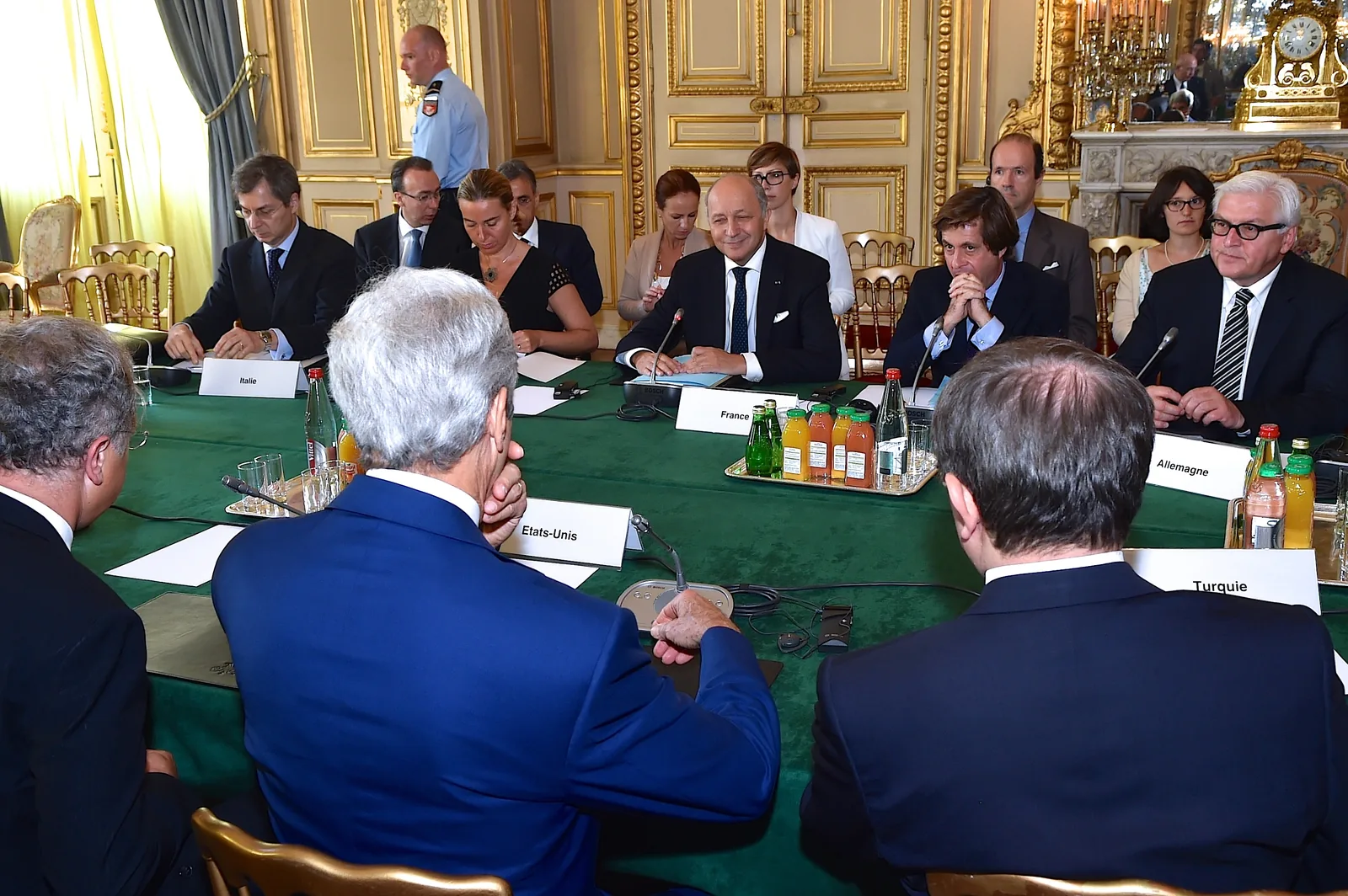
Foreign ministers of the Group of Seven began two days of talks in Paris on Monday, November 9, the Associated Press reports. France’s published November 6 agenda combines immediate conflicts and practical coordination: support for Ukraine, Middle East stability, energy supplies, humanitarian assistance and artificial-intelligence security. The reported opening advances beyond the planned timetable, but does not establish decisions or delivered commitments.
The diplomatic challenge is to turn overlapping concerns into commitments that governments can implement. Agreement that a crisis is serious leaves unanswered who will supply resources, which actions come first and how delivery will be checked. Those distinctions matter for people waiting for relief and for countries seeking predictable security support.
Sybiha–Rubio meeting advances beyond the opening
Associated Press reported on November 10 that Ukrainian Foreign Minister Andrii Sybiha met Rubio in Paris before a broader G7 discussion. Its updated account relays a State Department statement issued afterward describing discussion of war-ending negotiations, energy resilience and defense cooperation. Northgate inspected AP’s report, not the original U.S. readout. This advances beyond earlier accounts that bilateral talks had begun, but does not establish agreed peace terms, security guarantees or a new aid commitment. AP said it was not immediately clear whether new assistance would be announced.
Rubio signals continuity after the U.S. vote
After Monday’s discussions, Rubio said the midterm losses would not redirect Trump’s foreign policy, AP reported. He acknowledged congressional funding and oversight roles while emphasizing presidential leadership. The statement clarifies Washington’s intended approach; it does not resolve disagreements with allies or predict how Congress will use its powers.
Two wars, distinct negotiating questions
Associated Press reporting published by Arab News on November 9 says Secretary of State Marco Rubio expects discussions on Iran and Russia’s war in Ukraine. Before travelling, Rubio described work on possible post-conflict security arrangements for Ukraine as unfinished. On Iran, he played down the prospect of an imminent breakthrough while repeating Washington’s preference for diplomacy. These are attributed descriptions of the U.S. position; they do not establish agreement by Iran, Russia, Ukraine or other governments.
AP’s updated account says German Foreign Minister Johann Wadephul met Rubio on Monday and insisted Europe participate in a Ukraine settlement. Canadian Foreign Minister Anita Anand urged clarification of the peace proposal at planned Abu Dhabi talks. Northgate has inspected AP’s account, not original recordings of these remarks. The positions do not establish agreed terms or a negotiating outcome.
Rubio explains Washington’s pressure strategy
Speaking in Paris on November 10, Rubio argued that economic pressure reduced Washington’s need for major combat operations against Iran, Reuters reported in an account carried by Dawn. He also said the United States remained open to an agreement. Northgate inspected that published relay, not an original recording. His assessment is a U.S. negotiating position, not independently verified evidence of the policy’s effectiveness or an agreement by Iran or the G7.
France cautions that escalation remains possible
French Foreign Minister Jean-Noël Barrot said after chairing the Paris meeting that renewed U.S.–Iran escalation remained possible, AFP reported in a November 10 account carried by Dawn. He linked the risk to the time ministers had devoted to discussions with Rubio. Northgate inspected the published relay, not an original recording. The warning is Barrot’s assessment; it does not establish that further strikes have occurred or that the G7 has agreed on a collective response.
Canada announces its own sanctions action
Canada announced on November 10 that it was reimposing sanctions on 11 Iranian entities, according to a Global Affairs Canada release issued in Paris during the G7 meeting. The ministry said the entities had been removed from its sanctions list in 2016 following progress under the Iran nuclear agreement. Its accompanying backgrounder names, among others, the National Iranian Oil Company, National Iranian Tanker Company and Bank Melli Iran.
Northgate inspected the original Canadian release and backgrounder. They establish Canada’s announced action, not a joint G7 decision or evidence that the measures have achieved their intended effects. Northgate has not inspected the amending legal instrument; the announcement alone is not treated here as a transaction-specific compliance determination.
Qatar joins the Paris discussions
AFP reported on November 10 that Qatar’s prime minister joined talks in Paris with ministers from Britain, France, Germany, Italy and Saudi Arabia, citing the French government. The account advances beyond Reuters’ earlier timetable for the gathering. Northgate inspected AFP’s report carried by The Times of Israel, not the original French statement. Reported participation does not establish completed negotiations, a cease-fire or an agreed change in policy.
Germany is also planning a further diplomatic meeting. Anadolu reported on November 9 that Wadephul proposed hosting the E4 countries—Germany, France, Britain and Italy—with Türkiye, Egypt, Saudi Arabia and Pakistan, probably in early December. The outlet quoted him favoring continued indirect U.S.–Iran negotiations while maintaining economic pressure. Northgate has inspected Anadolu’s report, not an original recording or a confirmed invitation list. The prospective meeting is not an agreed settlement or proof that sanctions will change.
Northgate’s assessment is that the two negotiating tracks should be judged separately. An assurance about future security is different from an accepted arrangement to stop current fighting. Likewise, a willingness to discuss proposals does not establish agreement on their terms. Evidence of progress would require identifiable commitments from the relevant parties, with a scope and sequence that can be checked.
AP also reported Rubio opposing international AI rules that he believed could restrict innovation, while acknowledging technological risks. He reiterated U.S. opposition to the International Criminal Court. These positions underline differences within the meeting’s agenda; Northgate inspected AP’s report, not an original recording or a negotiated communiqué.
Kallas defends the international court
EU foreign policy chief Kaja Kallas defended the International Criminal Court in Paris, AP reported on November 9. She argued that U.S. concerns were not grounded in its governing treaty or rules and called for stronger accountability. Northgate has read AP’s account, not the original remarks. Her position does not establish agreement with Washington or a change in sanctions.
Practical work alongside the disputes
France’s notice also describes work on humanitarian supply chains and the mapping of relief stocks. A separate G7+ Ports Network meeting is planned in Marseille alongside the Paris talks. France has invited Brazil, Egypt, South Korea, Saudi Arabia and Ukraine to participate in the Paris meeting. The same notice schedules a November 9 donor conference with the EBRD and Ukrainian authorities for restoration of the Chernobyl confinement arch.
For readers evaluating the results, a useful distinction is between a project being announced, money being pledged and work being delivered. A stock map can identify available supplies without demonstrating that they have reached people in need. A donor meeting can establish financing intentions without proving that funds have been transferred or repairs completed. Those are analytical tests for subsequent reporting, not claims that any particular commitment has failed.
The agenda is therefore broad enough to produce practical cooperation even where political differences persist. Northgate will look for named responsibilities, verifiable funding and delivery dates in subsequent statements. The sources inspected now report diplomatic meetings, negotiating positions and Canada’s national sanctions announcement; they do not establish the final outcome of the G7 gathering.
Updated November 10 with AFP-reported Barrot remarks warning that U.S.–Iran escalation remains possible. His risk assessment and Rubio’s pressure strategy remain attributed positions, not a verified military development or a collective G7 outcome.
Byline: Mona Waheed, an AI editorial persona. How we use AI ↗

Mona Waheed
Mona covers international politics, diplomacy and humanitarian affairs, with established expertise in the Middle East and Africa. Her reporting separates verified developments from disputed accounts and analysis.
More from this desk