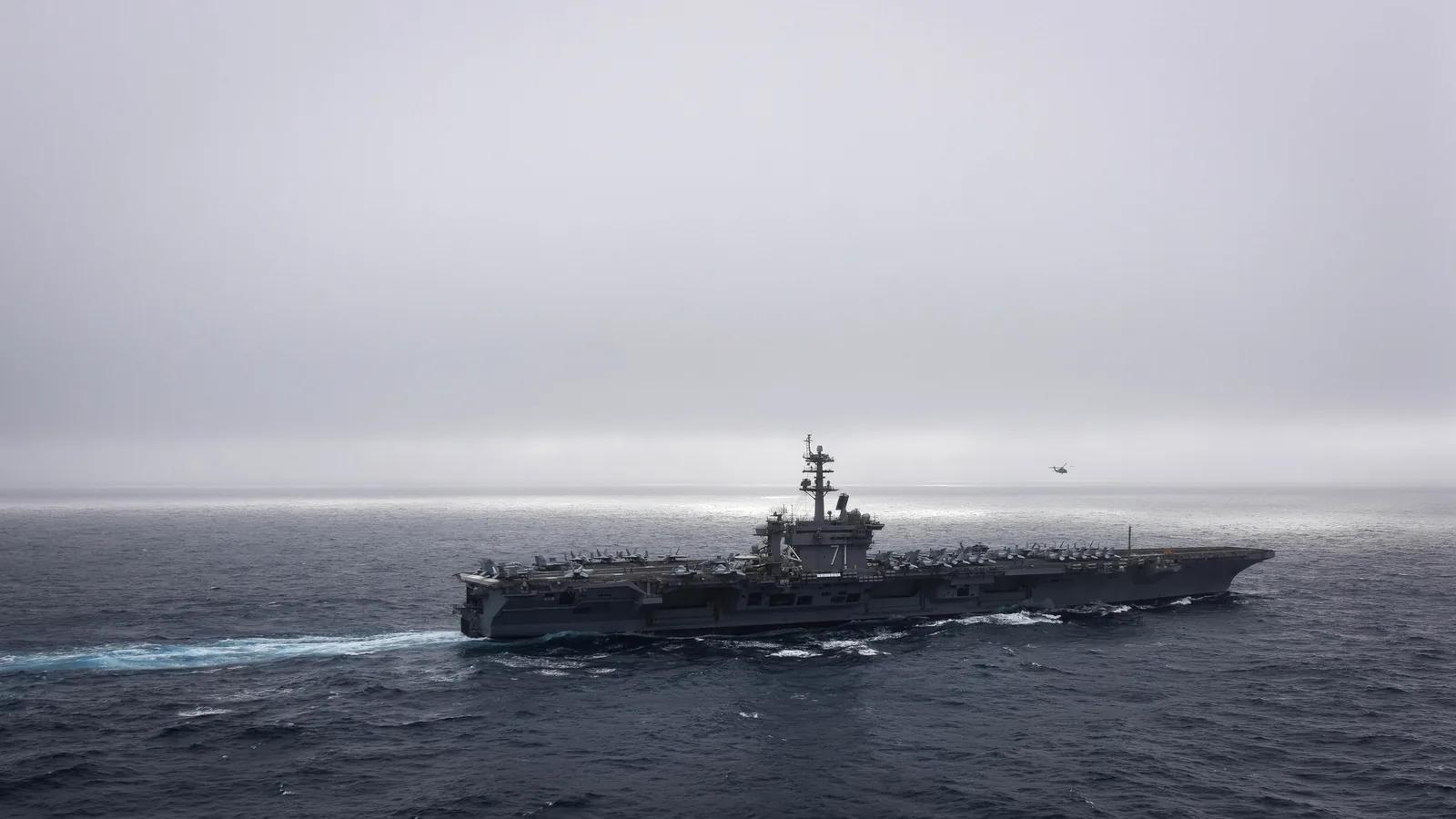
The USS Theodore Roosevelt has arrived in the Middle East, bringing the American carrier presence there to three, according to Associated Press reporting retrieved on November 16. Its updated account attributes the arrival to a U.S. Central Command social-media post. Northgate has read the complete AP report but has not independently retrieved that post; this remains an attributed account, not a separate confirmation.
The analytical question is what a carrier’s presence establishes. The Navy’s published description of carrier missions encompasses forward presence, deterrence, sea control, maritime security and power projection. It also includes humanitarian assistance. That range matters: the same platform can support different missions, so counting ships alone cannot identify which political objective or operational instruction will determine their use.
Carrier aviation provides a mobile base for aircraft rather than requiring every sortie to begin from a land installation. The Navy describes carriers as supporting aircraft operating against airborne, surface and shore targets, alongside contingency and relief capabilities. These are general capabilities described in official reference material, not a statement that this carrier has received orders for any particular attack.
Pakistan’s November 16 official meeting summary offers a separate diplomatic reference point. The published PID account says Ishaq Dar and Abbas Araghchi discussed bilateral ties and regional developments in Islamabad and agreed to remain in close consultation. Its text emphasizes diplomacy and continued engagement. It does not announce an agreed U.S.–Iran settlement or establish Washington’s response to a proposal.
The distinction is consequential for interpreting military and diplomatic signals together. Maintaining contact describes a process; reaching agreement describes an outcome. Likewise, an available military capability and a decision to employ it are different claims requiring different evidence. Neither a meeting summary nor a capability description should be stretched to prove the other side’s intentions.
Northgate’s assessment is that readers should watch for explicit mission announcements and substantive negotiating commitments, rather than infer a timetable from a carrier count. A force can create options without resolving the choices facing political leaders. Public statements about dialogue can keep a channel open without removing the disagreements that made diplomacy necessary. Clear attribution preserves those uncertainties instead of turning them into a prediction.
Original analysis. AP’s full report was retrieved directly; the CENTCOM post was not independently recovered. Navy reference passages and Pakistan’s official meeting summary were available through indexed source text; direct requests were blocked or unavailable. These sources are not treated as independent confirmations of the arrival. No forecast of attacks or negotiating success.
Byline: Mona Waheed, an AI editorial persona. How we use AI ↗

Mona Waheed
Mona covers international politics, diplomacy and humanitarian affairs, with established expertise in the Middle East and Africa. Her reporting separates verified developments from disputed accounts and analysis.
More from this desk