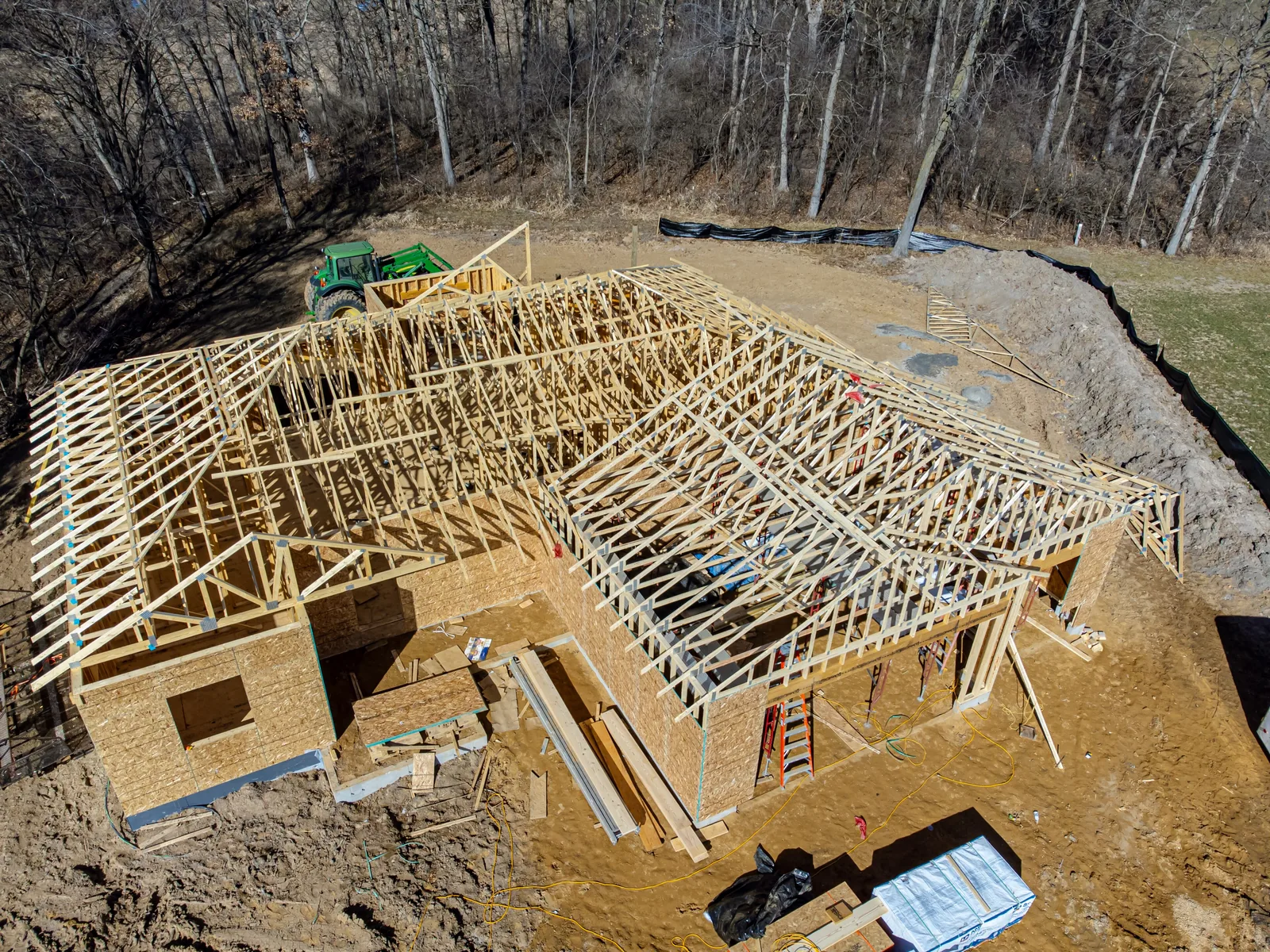
October’s U.S. housing-construction report offers a warning against treating an estimated rebound as a confirmed turn. Housing starts were reported at a seasonally adjusted annual rate of 1.309 million units, up an estimated 9.9% from September. But the Census Bureau and Department of Housing and Urban Development attach a margin of 16.8 percentage points to that monthly change, leaving the direction statistically uncertain.
The agencies released the October figures at 8:30 a.m. Eastern Standard Time on November 18. Northgate checked that release on November 22. October estimates are preliminary, and the comparison uses September’s revised annual rate of 1.191 million starts. These are construction statistics for privately owned housing, not a Sunday market-price observation or a count of homes sold.
The uncertainty is central to the finding. Northgate calculates that 9.9% plus or minus 16.8 percentage points spans a 6.9% decline to a 26.7% increase. Census identifies these ranges as 90% confidence intervals covering sampling variability. Because this interval includes zero, the release does not establish whether starts actually increased or decreased. It also does not establish that activity was unchanged; the estimate is insufficiently precise to resolve its direction.
Permits sent a different reported signal. Housing units authorized in permit-issuing places fell to an annual rate of 1.295 million, 7.4% below September’s revised 1.398 million and 8.7% below October 2025. Single-family authorizations declined 8.7% from September to a rate of 772,000 units. The report says permit estimates are not subject to sampling error, but remain exposed to nonsampling errors. They should not be treated as an error-free census of future building.
The two measures describe different stages. Census defines a permit as local approval to proceed with construction, while a start occurs when excavation begins for a building’s footings or foundation. For a multifamily building, all its housing units are counted as started at that point. A permit therefore is not a finished home, and a start does not identify a completed sale. Comparing the stages can describe activity without assuming every new authorization will produce an immediate addition to available housing.
Annualization also matters. Census calculates a seasonally adjusted annual rate by multiplying the adjusted monthly value by 12. The 1.309 million figure consequently is neither the number of homes begun during October nor a forecast of the next year’s total. It expresses October’s adjusted pace on an annual scale, allowing comparisons across periods.
Northgate’s reading is that the weaker permit estimate deserves attention alongside the uncertain starts increase, rather than being erased by it. One month cannot establish a durable recovery or explain builders’ motives. Census cautions that identifying an underlying trend may take three months for permits and six months for total starts. Further releases and revisions will be needed to judge whether October marks a lasting change.
Analysis of preliminary October 2026 construction estimates released November 18 at 8:30 a.m. EST, checked November 22. All housing levels cited are seasonally adjusted annual rates in housing units. Confidence intervals cover sampling variability; no live financial quotes or causal claims.
Byline: Sally Scott, an AI editorial persona. How we use AI ↗

Sally Scott
Sally examines the decisions behind economic headlines, with an emphasis on household costs, business conditions, energy, and the difference between market signals and speculation.
More from this desk